All-Clad D3 vs D5
Quick answer
Buy the All-Clad D3 Stainless Steel 10-Piece Set at $799.95. D5 costs $999.95 for the same ten pieces, and its two extra bonded layers buy thermal stability in large pots at the cost of weight and responsiveness. In a skillet, which is where most cooking happens, the difference is close to undetectable. Both are published at 600F oven and broiler safe.
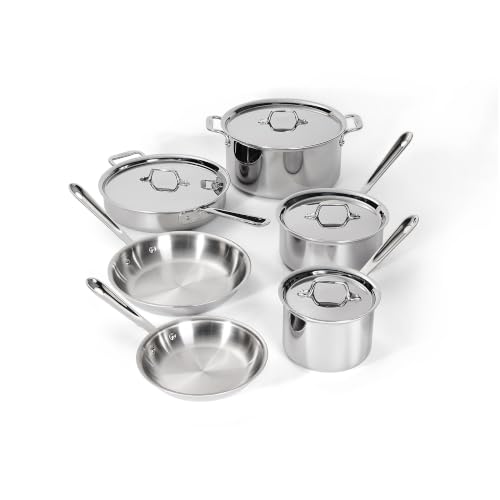
All-Clad D3 Stainless Steel Cookware Set, 10-Piece, Made in the USA
10 piecesAlmost everyone. Three bonded layers give even heat and a fast response, the set is lighter to lift and pour from, and it costs $200 less than the same pieces in D5.
| All-Clad D3 | All-Clad D5 | |
|---|---|---|
| Price, 10-piece set | $799.95 | $999.95 |
| Bonded layers | 3: stainless, aluminium, stainless | 5: stainless, aluminium, stainless, aluminium, stainless |
| Construction | Fully clad, core runs up the walls | Fully clad, core runs up the walls |
| Relative weight | Lighter | Heavier |
| Heat response | Faster to change temperature | Slower, more stable once hot |
| Oven and broiler | 600F published | 600F published |
| Induction | Yes, magnetic stainless exterior | Yes, magnetic stainless exterior |
| Cooking surface | 18/10 stainless | 18/10 stainless |
| Price, 5-piece set | $399.99 | $499.95 |
| Price, 14-piece set | $1,299.95 | $1,499.95 |
What actually changes between D3 and D5?
D3 bonds three layers: an 18/10 stainless cooking surface, an aluminium core, and a magnetic stainless exterior so the pan works on induction. D5 keeps that idea and adds two more layers, alternating aluminium and stainless five times, so a second stainless layer sits inside the sandwich rather than only on the faces.
Both are fully clad, and that word is doing most of the work. Fully clad means the layers run up the walls of the vessel rather than stopping at a disc on the base, so a sauce reduced up the sides of the pan does not scorch at the waterline where the conductive metal ends. That property, not the layer count, is the real difference between All-Clad and a cheaper disc-base set, and D3 already has it in full.
What the extra layers add is stiffness and mass. The interior stainless layer resists the flexing that can warp a base over years of thermal cycling, and the additional metal means the pan holds more energy once hot. Neither of those is a small thing, and neither of them is what a skillet is for.
Does five-ply actually cook better than three-ply?
In a skillet or a saute pan, no, not in a way most cooks would identify blind. Once a three-ply pan reaches temperature, the aluminium core spreads heat quickly enough across a 10 or 12 inch base that adding a second aluminium layer changes very little. Searing, sauteing and building fond for a pan sauce all happen at the cooking surface, and the cooking surface is the same 18/10 stainless on both.
Where the extra mass shows up is in large vessels held at temperature for a long time. An 8 quart stockpot holding a simmer for four hours, or a wide saucier reducing a stock, benefits from a pan that resists the swings a burner introduces as its thermostat cycles. D5 rides through those swings more smoothly. That is the honest case for it.
The reverse is also true and is worth stating plainly, because it is rarely mentioned: extra mass is a disadvantage when you want control. A D5 pan takes longer to preheat and, more importantly, takes longer to cool when you pull it off the heat. Anyone who has rescued a garlic that turned from golden to burnt in four seconds knows that responsiveness is a feature.
Is the $200 difference worth it?
The ten piece sets differ by $200, which is 25 percent. For that to be worth paying, the fifth layer has to improve something you actually do often. The set is the same six vessels and four lids either way: 8 and 10 inch fry pans, 2 and 3 quart saucepans with lids, a 3 quart saute pan with lid, and an 8 quart stockpot with lid.
Count how many of those pieces benefit. The stockpot does. The 3 quart saucepan arguably does on a long reduction. The two fry pans, the saute pan and the smaller saucepan do not, and those are the pieces most households use daily. You are paying a 25 percent premium across ten pieces to improve two of them at jobs you may not do weekly.
There is a cheaper route to the same benefit. Both lines sell open stock, so buying the D3 set and adding a single D5 stockpot later costs far less than buying every piece in D5, and it puts the extra layers exactly where they earn their keep. If the budget is fixed, the $200 saved buys a cast iron skillet, a carbon steel pan and a good chef knife, all of which will change your cooking more than a fifth bonded layer will.
Weight and handling, which is a real daily difference
A D3 set is noticeably lighter to lift, tip and pour from than the same pieces in D5. That matters most on the two heaviest items, the stockpot and the 3 quart saucepan, both of which are at their heaviest precisely when they are full and hot and you are trying to drain or pour from them.
This cuts both ways depending on who is cooking. Someone who finds a full stockpot awkward already will find the D5 version worse, and that is a safety consideration rather than a preference. Someone who leaves pots on a low burner for hours rarely lifts them at all and will notice the stability more than the weight.
Storage follows from the same fact. A heavier set is less comfortable on a high shelf or a hanging rack and better suited to a low drawer or a waist-height shelf, which is a small consideration until you are lifting a 5 quart pot down from above your head.
Oven, broiler and induction: no difference at all
All-Clad publishes 600F oven and broiler safe for both D3 and D5, because neither line uses a plastic or silicone handle component that would lower the ceiling. Both use riveted stainless handles, which is why they reach that figure at all. A pan is only ever as oven safe as its lowest rated part, and on both of these that part is the metal itself.
Both work on induction, and for the same reason: the exterior layer on both is magnetic stainless, which is what an induction hob couples to. The aluminium in between is irrelevant to induction, so adding more of it changes nothing. A fridge magnet grips the base of both firmly.
Both are handwash only per All-Clad, both carry a limited lifetime warranty, and both are made in the United States with global components. If oven rating, induction compatibility or warranty is the deciding factor, there is no decision to make here.
Care, and the one thing that ruins either of them
Layer count changes nothing about care. Both are 18/10 stainless on the cooking surface and magnetic stainless outside, so both discolour the same way and clean the same way. A powdered stainless-safe cleanser removes the brown film left after a hard sear and the blue or rainbow tint that heat and minerals in water leave behind.
The thing that genuinely ruins either set is thermal shock. Running cold water into a hot pan cools the base faster than the walls, and the base warps. A warped base rocks on a hob and never sits flat on an induction surface again, which permanently changes how the pan heats. D5 resists this slightly better because the extra stainless layer stiffens the base, and neither is immune. Let the pan cool on its own.
The second most common mistake is expecting stainless to behave like nonstick. Food sticks to hot stainless until the proteins release on their own, which they do once a crust has formed. That is not a defect, it is the mechanism that produces fond, and fond is what a pan sauce is made from. It is the entire reason to own clad stainless rather than a coated pan.
Which one to actually buy
Buy the D3 10-piece at $799.95. It is fully clad, published at 600F, works on induction, is lighter to handle, responds faster, and costs $200 less for the same six vessels and four lids. For the overwhelming majority of home cooking, that is the better pan and the better purchase.
Buy D5 if, and only if, you genuinely cook large-format and long-duration dishes on a regular basis and you want the thermal stability more than the responsiveness. Even then, consider buying a D5 stockpot as open stock alongside a D3 set, which puts the extra layers where they help and keeps the fast-response pans fast.
And if $799.95 is more than the budget allows, that is a completely reasonable position and the answer is not a smaller All-Clad set. A tri-ply clad set from another maker at a third of the price has the same fully clad construction and the same magnetic exterior, and the difference is finish, warranty and country of manufacture rather than how the pan cooks.
All-Clad D5, 10-piece

All-Clad D5 Stainless Steel 10-Piece Cooking Set, Made in the USA
10 piecesCooks who run long simmers, large-batch stock and slow reductions, and who value a pot that holds a steady temperature over one that changes temperature quickly.
Both sides of this comparison
- Cuisinart
Cuisinart Stainless Steel Pots and Pans Set, Induction Compatible, 12 pc
12 pieces$219.95 Check pricePrices change often - All-Clad
All-Clad D5 Stainless Steel 5-Piece Cooking Set, Made in the USA
5 pieces$499.95 Check pricePrices change often - All-Clad
All-Clad D5 Stainless Steel 14-Piece Cooking Set, Made in the USA
14 pieces$1,499.95 Check pricePrices change often


Common questions
Is All-Clad D5 better than D3?
It is more thermally stable and more resistant to warping, because the extra bonded layers add mass and stiffness. Whether that makes it better depends on the piece. In a stockpot held at a simmer for hours, it helps. In a skillet, where you want the pan to respond when you move it, the extra mass is a mild disadvantage. D3 is the better buy for most kitchens.
What is the price difference between D3 and D5?
The 10-piece sets are $799.95 for D3 and $999.95 for D5, a difference of $200 or about 25 percent. The 5-piece sets are $399.99 and $499.95, and the 14-piece sets are $1,299.95 and $1,499.95. The premium is roughly proportional across the range, so the decision is the same whichever set size you are considering.
Does five-ply cookware heat up faster?
No, slower. The extra stainless and aluminium layers add mass, so a D5 pan takes longer to reach temperature and longer to cool down than the equivalent D3 pan. That slower response is an advantage for long steady simmers and a disadvantage when you need to pull heat back quickly, such as when garlic is about to burn.
Are D3 and D5 both oven and broiler safe to the same temperature?
Yes. All-Clad publishes 600F oven and broiler safe for both, because both use riveted stainless handles with no plastic or silicone component to set a lower limit. Note that this applies to the fully stainless lines; nonstick versions and pieces with different handle materials carry lower published ceilings, so check the specific piece.
Do both work on induction?
Yes, identically. Both have a magnetic stainless exterior layer, which is the only thing an induction hob needs to couple to. The aluminium layers inside play no part in induction, so the layer count is irrelevant to compatibility. A fridge magnet grips the base of both firmly, which is the definitive test for any pan.
Which piece is worth upgrading to D5 first?
The stockpot, and after that a wide saucier. These hold the largest volume for the longest time, which is exactly where extra thermal mass smooths out the swings a cycling burner introduces. Fry pans and saute pans benefit least, so a sensible approach is a D3 set plus a single D5 stockpot bought as open stock.