A 8 inch skillet when searing chicken thighs
Quick answer
A 8 inch skillet measures 8 inches across the rim and about 6 inches across the flat base, giving roughly 28 square inches of usable cooking surface. That holds 1 portion when searing chicken thighs, at 25 square inches per portion.
The geometry is exact. The area one portion needs in order to brown is a kitchen convention.
| Job | Area per portion | Portions it holds |
|---|---|---|
| Searing steaks | 25 sq in | 1 |
| Searing chicken thighs | 25 sq in | 1 |
| Sauteing vegetables | 16 sq in | 1 |
| Cooking pancakes | 20 sq in | 1 |
| Frying eggs | 14 sq in | 2 |
| Shallow frying | 25 sq in | 1 |
| Stir frying | 16 sq in | 1 |
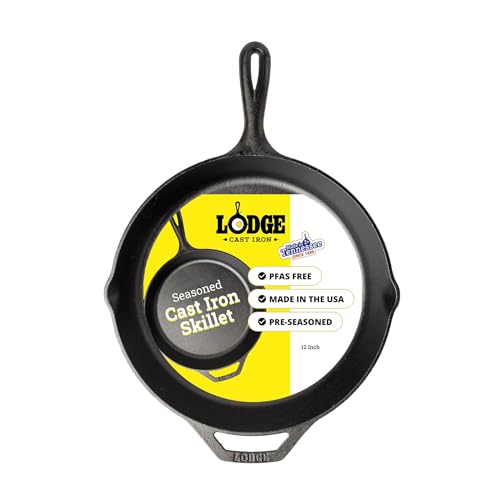
How big is a 8 inch skillet really?
A skillet is measured across the top rim, which is the widest point. Its flared walls mean the flat base that actually does the cooking is about 2 inches smaller, so a 8 inch pan gives roughly 6 inches of flat surface. In area terms that is 28 square inches rather than the 50 square inches the rim figure implies, a loss of about 44 percent.
This is the single most common source of disappointment in pan buying. People replace a 10 inch pan with a 12 inch pan expecting a large jump and get a smaller one than they hoped, because the flat surface went from 50 to 79 square inches rather than from 79 to 113.
Is a 8 inch skillet enough for a family?
For searing chicken thighs it holds 1 portion with enough room for moisture to escape. A household of four will need to cook in batches, or step up to a larger pan: a 14 inch pan holds four.
Cooking in batches is not a failure. A pan reheats in well under a minute, and two properly browned batches beat one crowded grey one. What does not work is turning the heat up to compensate, because the limit is evaporation rate rather than energy input.
Does the burner size matter?
Yes, particularly on gas. A pan much wider than the flame heats in a ring, with the centre hot and the outer inches of that 28 square inches noticeably cooler. On a thin pan this is severe; on thick cast iron the mass evens it out, which is one of the real arguments for iron. Induction is the best case, since the ring heats the whole magnetic base directly rather than heating a spot and relying on conduction.
8 inch pans and near sizes
- Lodge
Lodge Pre-Seasoned Cast Iron Skillet, PFAS-Free, 10.25 Inches
10.25 in$24.90 Check pricePrices change often - Tramontina
Tramontina Signature Tri-Ply Clad Stainless Steel 10-Inch Frying Pan
10 in$39.95 Check pricePrices change often - All-Clad
All-Clad D3 Stainless Steel 12" Fry Pan with Lid, Made in the USA
12 in$149.95 Check pricePrices change often - All-Clad
All-Clad D3 Stainless Steel Fry Pan Set, 10&12-inch, Made in the USA
12 in$249.99 Check pricePrices change often


Common questions
How many portions fit in a 8 inch skillet?
When searing chicken thighs, about 1. The pan has roughly 28 square inches of flat cooking surface and each portion needs about 25 square inches to brown rather than steam. Smaller items such as eggs fit more, and large seared pieces fit fewer, so the answer changes with what you are cooking.
What is the actual cooking surface of a 8 inch pan?
About 6 inches across, giving 28 square inches. The 8 inch figure is the rim measurement. Flared walls lose roughly 2 inches between the rim and the flat base, which is why the usable area is smaller than the advertised size suggests.
Should I buy a 8 inch pan or go larger?
Go larger only if you routinely cook more than 1 portion at once. Larger pans are heavier, slower to preheat, harder to store and heat unevenly on a small burner. A second pan on a second burner is usually a better answer than one very large pan.
Does a nonstick pan of this size hold the same amount?
The geometry is identical, so yes on area. What differs is how much crowding you get away with. A thin nonstick aluminium pan loses heat quickly when cold food lands, so the moisture problem shows up sooner than in thick iron of the same diameter. Nonstick is also rarely run at searing temperatures in the first place.
Can I measure the pan I already own?
Yes, and it is worth doing. Lay a ruler across the inside of the pan at the point where the base stops being flat and the walls begin to rise. That number, not the rim measurement, is what the area calculation should use. On most flared skillets it is about 2 inches less than the size on the box.