Tempered glass bakeware cookware
Quick answer
Tempered glass bakeware conducts heat at about 1 W/m-K, does not work on induction, and is oven safe to about 425F. Casseroles, baked pasta and anything you want to see the base of.
Conductivity and density are published material properties. Oven ceilings are what manufacturers publish for this class of cookware and vary by brand.
| Material | Conductivity | Induction | Oven ceiling | Reactive |
|---|---|---|---|---|
| Tri-ply stainless clad | 237 W/m-K | Yes | 600F | No |
| Five-ply stainless clad | 237 W/m-K | Yes | 600F | No |
| Disc-base stainless | 237 W/m-K | Yes | 500F | No |
| Bare cast iron | 52 W/m-K | Yes | 700F | Yes |
| Carbon steel | 50 W/m-K | Yes | 600F | Yes |
| Enamelled cast iron | 52 W/m-K | Yes | 500F | No |
| PTFE nonstick | 237 W/m-K | Depends | 400F | No |
| Ceramic nonstick | 237 W/m-K | Depends | 350F | No |
| Bare or anodised aluminium | 237 W/m-K | No | 500F | Yes |
| Plain stainless steel | 16 W/m-K | Depends | 500F | No |
| Copper, lined | 401 W/m-K | No | 450F | No |
| Stoneware and ceramic bakeware | 1.5 W/m-K | No | 450F | No |
| Tempered glass bakeware | 1 W/m-K | No | 425F | No |
| Wood | not applicable | No | Not oven safe | No |
| Polyethylene and polypropylene | not applicable | No | Not oven safe | No |

What is tempered glass bakeware?
Tempered soda-lime or borosilicate glass.
Thermal shock is the real hazard with glass. Never add liquid to a hot glass dish, never put it on a burner, and never move it straight from the fridge into a hot oven.
How it behaves on the heat
Its conductivity of about 1 W/m-K sits at the low end, which is why cookware rarely relies on it alone. Heat retention is medium, and responsiveness is low. Evenness is moderate, and it browns bases more than metal does.
Conductivity and heat capacity are different things and it is worth keeping them apart. Conductivity is how fast heat moves through the material. Heat capacity is how much energy the material holds once hot. Cast iron conducts poorly and holds a great deal, which is exactly why it sears well: the pan barely cools when cold food lands on it.
Induction, oven and care
It does not work on induction. No metal, so induction cannot heat it. The settling test is a fridge magnet on the base: a firm grip means it works.
The oven ceiling is about 425F. Pyrex publishes a 425F ceiling for its glass bakeware and prohibits broiler and stovetop use entirely. Dishwasher guidance: Yes.. It is not reactive, so acidic food presents no problem.
What it is genuinely best at
Casseroles, baked pasta and anything you want to see the base of.
On sticking: Somewhat.
Tempered glass bakeware cookware
- MALACASA
MALACASA 4.4QT Ceramic Casserole Dishes for Oven, 9x13 Baking Dishes, White
4.4 qt$24.28 Check pricePrices change often - Anchor Hocking
Anchor Hocking Glass Baking Dishes for Oven, 2 Piece Set (2 Qt & 3 Qt Glass Casserole Dishes)
3 qt · 2 pieces$25.99 Check pricePrices change often - MORA
Mora 9x13in Deep Porcelain Baking Dish - Oven to Table, Freezer Safe
13 in$39.99 Check pricePrices change often - Pyrex
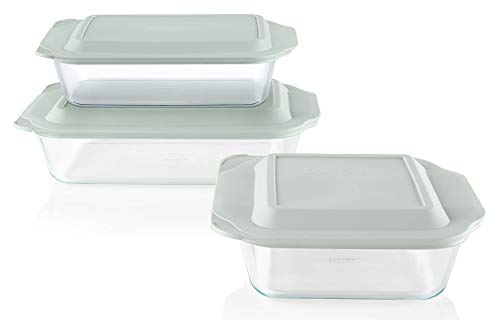
Pyrex Deep 3-Pack Glass Baking Dish Set (9"x13", 7"x11", 8"x8")
13 in$48.42 Check pricePrices change often


Common questions
Does tempered glass bakeware work on induction?
No. No metal, so induction cannot heat it. The reliable test is a fridge magnet against the base: a firm grip across the whole base means the pan will work, a grip only in the centre means uneven heating, and no grip means it will not work at all.
How hot can tempered glass bakeware go in the oven?
About 425F. Pyrex publishes a 425F ceiling for its glass bakeware and prohibits broiler and stovetop use entirely. Remember that the ceiling for any assembled pan is the lowest of its cooking surface, its handle and, if it goes in covered, its lid, and the handle is very often the lowest of the three.
Is tempered glass bakeware dishwasher safe?
Yes. Even where a dishwasher is technically permitted, hand washing extends the life of almost every kind of cookware, because detergents are aggressive and the heat cycle is harder on coatings and finishes than anything that happens during cooking.
Can I cook acidic food in tempered glass bakeware?
Yes. This material is inert, so tomatoes, wine, vinegar and citrus present no problem however long they cook. That is one of the main practical reasons to own it.
What is tempered glass bakeware best at?
Casseroles, baked pasta and anything you want to see the base of. No single cookware material is good at every job, which is why a mixed kitchen outperforms a matched set at every budget. Choose each vessel for what it will actually be used for rather than buying everything in one construction.