Ceramic nonstick with a riveted stainless handle
Quick answer
A pan with a ceramic nonstick cooking surface and a riveted stainless handle is oven safe to roughly 350F. The coating sets that ceiling: the ceramic nonstick surface is rated to 350F and the riveted stainless handle to 600F, and the lower of the two always wins.
These are the figures manufacturers publish for each class of part. Your own pan's documentation always wins over a general figure.
| Part | Published ceiling | Note |
|---|---|---|
| Ceramic nonstick (surface) | 350F | Published ceilings for sol-gel ceramic coatings commonly run 350F to 450F, generally below PTFE lines. |
| Riveted stainless (handle) | 600F | All-Clad publishes 600F for its riveted stainless handles. Many other brands publish 500F for the same construction. |
| Stainless lid, stainless knob (lid) | 500F | Matches the pan in almost every case. |
| Tempered glass lid (lid) | 400F | Glass lid ratings are commonly 350F to 425F, and nearly all of them prohibit the broiler. The lid is very often the lowest number in the whole stack. |
| Lid with a phenolic knob (lid) | 375F | Many enamelled cast iron pots shipped with a phenolic knob rated around 375F on a pot rated to 500F. A stainless replacement knob removes the limit. |
| Cast iron lid (lid) | 700F | No coating and no plastic, so it goes as hot as the pot. |
| Handle | Handle limit | Resulting ceiling |
|---|---|---|
| Riveted stainless | 600F | 350F |
| Integral cast iron | 700F | 350F |
| Welded stainless | 500F | 350F |
| Silicone sleeve | 400F | 350F |
| Phenolic or bakelite | 350F | 350F |
| Wood | Not oven safe | Do not put it in the oven |
| Hollow stay-cool stainless | 500F | 350F |
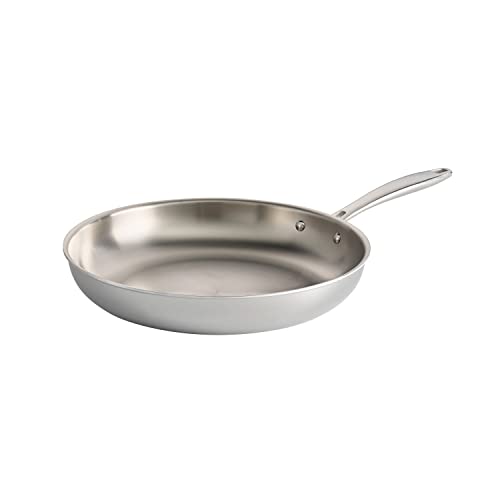
Tramontina Signature Tri-Ply Clad Stainless Steel 12-Inch Large Frying Pan
12 inWhy the handle usually decides, not the pan
The metal a pan is made from is far more heat tolerant than anything attached to it. Stainless and cast iron are unbothered by any normal oven temperature. What fails first is whatever was added to make the pan comfortable to hold: a silicone sleeve softens around 400F, and a phenolic handle chars around 350F. Handles exist to stay cool in your hand on the hob, and the materials that do that job best are precisely the ones that fail first in an oven.
In this combination the coating is the binding limit at 350F. Published ceilings for sol-gel ceramic coatings commonly run 350F to 450F, generally below PTFE lines.
The lid is part of the calculation when the pan goes in covered
A tempered glass lid is commonly published at 400F and nearly all of them prohibit the broiler outright. Enamelled cast iron pots frequently shipped with phenolic knobs rated around 375F on a pot rated to 500F, which means the knob alone cut the pot's usable range by a quarter.
That one is easy to fix. Most makers sell a stainless replacement knob as a spare part, and fitting it returns the pot to its own rating. Taking the lid off entirely works too. Uncovered, the lid does not enter the calculation at all.
Broiling is a separate question
An oven rating and a broiler rating are not the same thing. Under a broiler the element radiates directly onto the cooking surface, which can push a coating well past the air temperature in the oven. Many nonstick lines are prohibited under a broiler even when their oven figure looks comfortable, and glass bakeware is prohibited outright.
Bare metal is the exception. Cast iron, carbon steel and bare clad stainless have no coating to degrade, which is why those are the pans that go straight under a broiler without thinking about it.
What happens if you exceed it
It depends on which part gives way, and none of the outcomes are cosmetic. Exceeding a PTFE coating's rating degrades it and releases fumes that are rapidly fatal to pet birds. Exceeding a handle rating can char the material or weaken its attachment, and a handle failing on a full hot pan is a genuine injury risk. A glass lid pushed past its rating can shatter.
Oven capable cookware
- MALACASA
MALACASA 4.4QT Ceramic Casserole Dishes for Oven, 9x13 Baking Dishes, White
4.4 qt$24.28 Check pricePrices change often - M MCIRCO
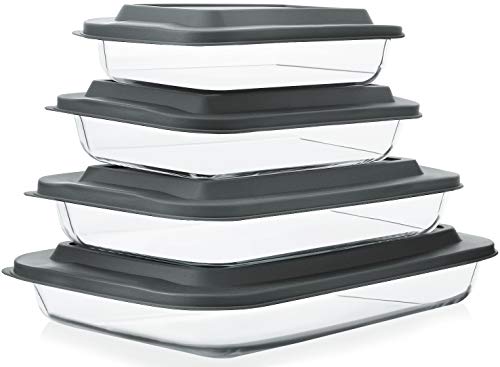
M MCIRCO 8 Piece Deep Glass Baking Dish with Lids, BPA free,Gray
8 pieces$35.99 Check pricePrices change often - All-Clad
All-Clad D3 Stainless Steel 12" Fry Pan with Lid, Made in the USA
12 in$149.95 Check pricePrices change often - Le Creuset
Le Creuset Enameled Cast Iron Round Dutch Oven, 5.5 qt., Flame
5.5 qt$278.99 Check pricePrices change often - Le Creuset
Le Creuset Enameled Cast Iron Round Dutch Oven, 7.25 qt., Cerise
7.25 qt$325.99 Check pricePrices change often




Common questions
How hot can a ceramic nonstick pan with a riveted stainless handle go?
About 350F. The ceramic nonstick surface is published to 350F and the riveted stainless handle to 600F, and a pan is only as oven safe as its lowest rated part. Check your own pan's documentation, because published figures vary between makers and lines.
Does a lid change the answer?
Yes, if the pan goes in covered. A tempered glass lid is commonly rated 400F and a phenolic lid knob about 375F, either of which can be lower than the pan itself. Uncovered, the lid does not matter. On an enamelled pot, swapping a phenolic knob for a stainless one is the single most effective upgrade available.
Can I put this pan under the broiler?
Only if the maker says so specifically. A broiler radiates directly onto the surface and can drive it well above the oven air temperature. Coated pans are frequently prohibited under a broiler even where the oven figure looks high enough. Bare metal pans, meaning cast iron, carbon steel and uncoated clad stainless, are the ones that reliably handle it.
Is exceeding the rating actually dangerous?
It can be. Overheated PTFE releases fumes that are rapidly fatal to pet birds and can cause temporary flu-like symptoms in people. A charred or weakened handle can fail while you are lifting a full, hot pan. A glass lid past its rating can shatter. These are not wear-and-tear issues, they are failures with consequences.
How do I raise a pan's oven ceiling?
The realistic options are to take the lid off, or to replace a phenolic lid knob with a stainless one. Handles and coatings cannot be changed. If you regularly need high oven or broiler heat, that is a genuine argument for an all-metal pan rather than a workaround on the one you own.