Pan size for 6 portions when searing steaks
Quick answer
6 portions searing steaks needs about 150 square inches of flat cooking surface, which is more than any commonly sold skillet provides. Cook in batches or use two pans across two burners rather than crowding one.
The area arithmetic is exact. How much surface one portion needs in order to brown rather than steam is a kitchen convention, stated openly here so you can adjust it.
| Rim size | Flat cooking surface | Usable area | Portions it fits | Enough for 6? |
|---|---|---|---|---|
| 6 in | 4 in | 13 sq in | 0 | No |
| 8 in | 6 in | 28 sq in | 1 | No |
| 10 in | 8 in | 50 sq in | 2 | No |
| 10.25 in | 8.3 in | 53 sq in | 2 | No |
| 12 in | 10 in | 79 sq in | 3 | No |
| 13 in | 11 in | 95 sq in | 3 | No |
| 14 in | 12 in | 113 sq in | 4 | No |
| 15 in | 13 in | 133 sq in | 5 | No |
How much pan does searing steaks actually need?
One portion searing steaks wants roughly 25 square inches of flat cooking surface around it. For 6 portions that comes to 150 square inches, which needs a flat base about 13.8 inches across. Adding the 2 inches a flared skillet loses between its rim and its base gives a rim measurement of 15.8 inches, and the nearest size actually sold is larger than anything on the shelf.
The figure of 25 square inches per portion is a convention rather than a specification, and it exists for a physical reason. Food releases moisture as it cooks, and that moisture has to leave the pan as steam. Crowd the surface below about 20 square inches per portion and the moisture cannot escape fast enough, so the food sits in liquid at roughly the boiling point of water. Browning needs a far hotter and drier surface than that.
Why a 12 inch pan is not 12 inches of cooking surface
Cookware is measured across the top rim, and a skillet has flared walls so that a spatula can get underneath food and so that the contents can be tossed. Those walls mean the flat base is smaller than the advertised size by roughly 2 inches. A pan sold as 12 inches gives about 10 inches of flat base, which is 79 square inches rather than the 113 square inches the rim figure suggests. That is a difference of about 31 percent.
A straight-sided saute pan loses almost nothing, only about 0.5 of an inch, so for a given rim measurement it holds considerably more. That is the main practical argument for owning one alongside a skillet.
What happens if you use a smaller pan anyway
Nothing dramatic, and nothing good either. The pan temperature drops when the food goes in, the released moisture pools instead of evaporating, and the surface of the food steams. It cooks through perfectly safely and it comes out grey and soft rather than browned. Turning the heat up does not fix it, because the limiting factor is how fast liquid can leave the pan, not how much energy is arriving.
The reliable fix is to cook in batches. Two smaller batches in the right pan beat one crowded batch every time, and the pan reheats between them in under a minute.
Pans suited to searing steaks
- Lodge
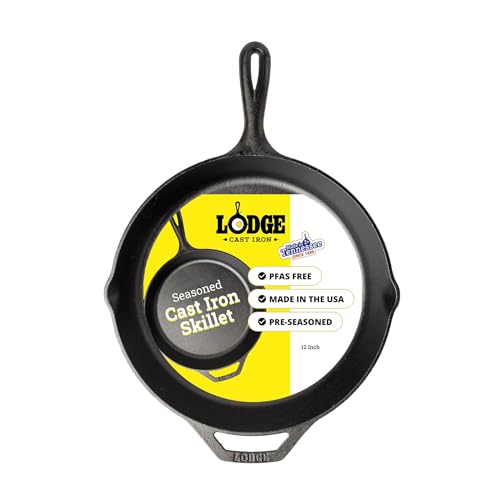
Lodge Pre-Seasoned Cast Iron Skillet, PFAS-Free, 10.25 Inches
10.25 in$24.90 Check pricePrices change often - Tramontina
Tramontina Signature Tri-Ply Clad Stainless Steel 10-Inch Frying Pan
10 in$39.95 Check pricePrices change often - All-Clad
All-Clad D3 Stainless Steel 12" Fry Pan with Lid, Made in the USA
12 in$149.95 Check pricePrices change often - All-Clad
All-Clad D3 Stainless Steel Fry Pan Set, 10&12-inch, Made in the USA
12 in$249.99 Check pricePrices change often


Common questions
What size skillet do I need for 6 portions?
No single commonly sold skillet is large enough. The largest common size, 15 inches, holds about 5 portions without crowding. Use two pans or cook in batches rather than forcing everything into one.
Why does crowding a pan stop food browning?
Food releases moisture as it heats. If the surface is crowded, that moisture cannot evaporate fast enough and it pools, holding the food at roughly the boiling point of water. The browning reactions that create crust and flavour need a much hotter, drier surface. The food still cooks through, it simply comes out pale and soft instead of browned.
Is a bigger pan always safer to buy?
No. A pan much wider than the burner heats unevenly, with a hot ring in the middle and cooler edges, and a very large pan is heavy, awkward to store and slow to preheat. Matching the pan to the batch you normally cook works better, and a second medium pan on a second burner beats one oversized pan for most households.
Does the pan material change the size I need?
Not the arithmetic, but it changes how much crowding you get away with. A thick cast iron pan holds far more heat in its mass, so the temperature drops less when cold food lands and moisture keeps evaporating. A thin pan cools immediately and crowding shows up much faster. The area figures here are the same either way.
How do I measure my existing pan properly?
Measure the flat base, not the rim, because the flat base is what actually cooks. Put a ruler across the inside of the pan at the point where the walls start to curve upward. On a typical flared skillet that number is about 2 inches smaller than the size printed on the box or stamped on the handle.