Stainless Steel vs Nonstick
Quick answer
Most kitchens need both: the Cuisinart 77-10P1 10-Piece Stainless Set ($169.21) for searing, deglazing and high-heat cooking, and a nonstick pan or two like the T-fal Ultimate Hard Anodized 12-Piece Set ($159.99) for eggs, fish and delicate foods that would otherwise stick.

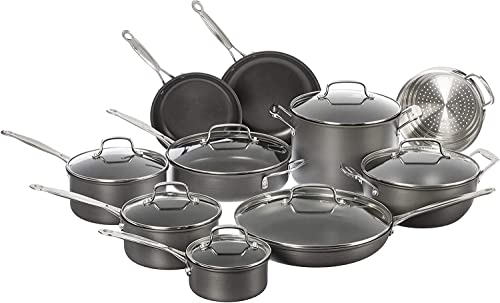
Cuisinart 77-10P1 10-Piece Chef's-Classic-Stainless Collection, Cookware Set
10 piecesSearing meat, deglazing pan sauces, and any cooking that needs high, sustained heat without worrying about coating damage.
| Stainless Steel | Nonstick | |
|---|---|---|
| Thermal conductivity | About 16 W/m-K, poor on its own | Aluminum or hard-anodized core, much higher |
| Sticking at high heat | Common until food releases naturally | Minimal by design |
| Searing and browning | Excellent, builds fond for sauces | Weaker, coating limits crust development |
| Coating lifespan | No coating to wear out | Degrades over 1 to 3 years of regular use |
| Oven safe temperature | Often 500F or higher | Commonly 400F, lid safe around 350F |
| Metal utensil safe | Yes | No, damages coating |
| Price, comparable set | $169.21 | $159.99 |
Why food sticks to stainless steel
Stainless steel is a relatively poor heat conductor on its own, moving heat at roughly 16 W/m-K compared to aluminum's 237, which is why bare stainless cookware is almost always built with an aluminum or copper core to compensate. That core solves even heating, but it does not change the surface chemistry that causes sticking. This is also why genuinely single-layer stainless cookware, with no core material at all, is rare in modern kitchens outside of very inexpensive pieces not meant for serious cooking.
Food sticks to hot stainless because proteins in meat, eggs, and fish bond to the metal surface on contact and only release once a proper crust forms underneath. Move the food too early and it tears, leaving residue behind and looking like the pan is defective when it is actually just too soon to flip. This is normal behavior, not a flaw, and it resolves itself with enough preheat time and enough oil.
A simple water test helps gauge readiness: a few drops of water flicked into a properly preheated stainless pan will bead up and skitter across the surface rather than evaporating immediately, a sign the pan and oil are hot enough for food to be added without excessive sticking.
Why nonstick avoids that problem entirely
Nonstick cookware solves sticking with a coating, either PTFE or a ceramic sol-gel formula, applied over an aluminum or hard-anodized aluminum base. The coating creates a low-friction surface that food releases from almost immediately, which is why eggs slide out of a nonstick pan with barely any oil while the same eggs would bond to bare stainless in seconds. Neither coating changes the underlying metal's conductivity meaningfully, so a nonstick pan still relies on an aluminum base for even heating, the coating only addresses the surface release problem.
The tradeoff is that the coating is a consumable part of the pan, not a permanent one. It wears down with metal utensils, high heat, and abrasive scrubbing, and once it degrades, the pan loses its main advantage and needs replacing rather than repairing.
Searing and browning: stainless wins clearly
Getting a deep, browned crust on meat requires high, sustained heat and direct contact between the food and a very hot metal surface, both of which stainless steel handles better than nonstick. Stainless can be preheated hot enough and held there long enough to build a proper sear, and once the food is done, the browned bits left in the pan, called fond, become the base for a pan sauce.
Nonstick coatings are not rated for the same sustained high heat and generally will not build the same crust or fond, since the coating is specifically designed to prevent food from bonding to the surface at all. A nonstick pan can brown food lightly, but it will not match a stainless or cast iron sear on a steak.
This makes stainless the better tool for recipes that deglaze the pan afterward, since the fond left behind after searing meat or vegetables in stainless dissolves into wine, stock, or water to build a pan sauce in the same pan the searing happened in, a technique that does not work on nonstick since there is little to no fond to begin with.
Temperature limits and oven safety
Fully stainless cookware, like the Cuisinart 77-10P1 set, generally carries higher oven-safe ratings, often 500F or more, since there is no coating or plastic component to break down under sustained heat. That makes stainless pans and pots more flexible for stovetop-to-oven recipes, braises, and broiling.
Nonstick cookware, including the T-fal Ultimate set, is commonly rated lower, around 400F for the pan body and roughly 350F for a lid, because PTFE coatings begin to break down as they approach 500F and manufacturers build in a safety margin below that point. Always check the specific rating on any nonstick pan before putting it in a hot oven or under a broiler, since exceeding the coating's rated temperature degrades it faster and releases fumes that are especially dangerous to pet birds.
Durability, everyday care, and utensils
Stainless cookware has no coating to wear out, so a well-made set can last decades with normal care, avoiding overheating an empty pan and hand-washing to prevent water spotting. It also tolerates metal utensils, scouring pads, and the dishwasher without damage to the cooking surface, which makes it forgiving for busy kitchens.
Nonstick cookware has a shorter functional lifespan, typically 1 to 3 years of regular use before the coating loses meaningful release, faster if metal utensils or high heat are used against manufacturer guidance. Nonstick pans require wood, silicone, or plastic utensils and gentle washing to protect the coating, and using metal tools is one of the fastest ways to scratch through it and shorten its life.
Stainless steel can also develop cosmetic discoloration from overheating, sometimes called heat tint or a rainbow effect, which does not damage the pan's function but can be removed with a stainless-safe cleaner if appearance matters. Nonstick coatings that discolor, by contrast, are usually signaling actual degradation of the coating rather than a purely cosmetic change.
Induction compatibility and everyday weight and handling
Fully stainless cookware and hard-anodized nonstick cookware both need a magnetic base layer to work on an induction cooktop, since induction burners generate heat through a magnetic field rather than a traditional flame or resistance coil. Most modern sets, including the Cuisinart 77-10P1 and T-fal Ultimate lines, are built with an induction-compatible base, but this is worth confirming on the specific listing before buying.
Stainless cookware with a thick aluminum or copper core, like the pieces in the Cuisinart 77-10P1 set, tends to feel substantial in hand, which also makes larger pieces noticeably heavier to lift and pour from when full. Nonstick cookware, especially hard-anodized aluminum construction like the T-fal Ultimate set, is generally lighter for a comparable size, which some cooks find easier to maneuver for daily tasks.
Building a set and budgeting for replacement over time
The most practical approach for most kitchens is a stainless set for the bulk of cooking, sauces, soups, braises, and searing, paired with one or two dedicated nonstick pans sized for eggs and delicate fish. The Cuisinart 77-10P1 covers the stainless side with 10 pieces at $169.21, and a set like the T-fal Ultimate Hard Anodized 12-Piece at $159.99 adds nonstick coverage without duplicating pieces already handled well by stainless.
A stainless set purchased once can reasonably be expected to last decades without replacement, dropping its effective annual cost every year it stays in service. A nonstick set needs to be budgeted differently, since the coating on its most-used pieces will need replacing well before the set's larger pieces show wear; some cooks address this by replacing only the specific worn nonstick pan rather than the whole set. For a first kitchen on a limited budget, prioritizing stainless generally makes more financial sense over several years, adding a single inexpensive nonstick pan later once the budget allows.
Nonstick (T-fal Ultimate)

T-fal Ultimate Hard Anodized Nonstick Cookware Set 12 Piece, Oven Broiler Safe 400F, Lid Safe 350F, Kitchen Cooking Set w/Fry Pans, Saucepans, Dutch Oven, Pots and Pans, Dishwasher Safe, Onyx
12 piecesEggs, fish, pancakes and other delicate foods where release matters more than a deep sear, cooked at low to medium heat.
Both sides of this comparison
- CAROTE
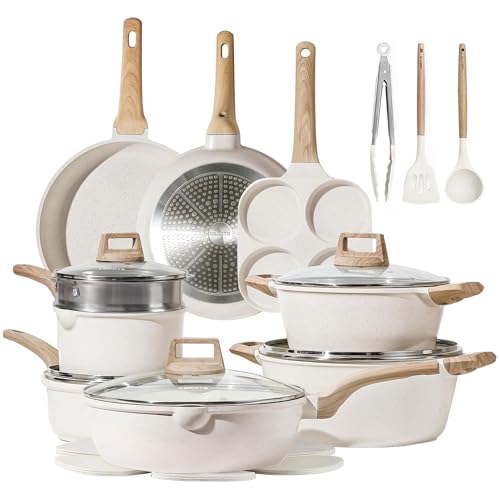
CAROTE 21pcs Pots and Pans Set Non Stick, Detachable Handle Cookware, Black
21 pieces$59.99 Check pricePrices change often - E-far
E-far Stainless Steel Cookware Set, 10-Piece Induction Pots and Pans Set
10 pieces$80.74 Check pricePrices change often - CAROTE
CAROTE 21pcs Pots and Pans Set, Nonstick Cookware Sets, with Egg Pan
21 pieces$189.99 Check pricePrices change often


Common questions
Is stainless steel or nonstick better for beginners?
Nonstick is more forgiving for beginners because food releases easily and there is less risk of a stuck, torn egg or fish fillet. Stainless has a learning curve around preheating and letting food release naturally, but it rewards that learning with better searing and no coating to wear out over time.
Why does my food stick to my stainless steel pan?
Food bonds to hot stainless steel until a proper crust forms underneath, and moving it too early tears the food and leaves residue on the pan. Preheat the pan before adding oil, make sure the oil is hot before adding food, and wait for the food to release on its own rather than forcing it with a spatula.
How long does nonstick coating actually last?
Most nonstick cookware holds meaningful release for roughly 1 to 3 years of regular use, less if metal utensils, high heat, or abrasive scrubbing are used against the manufacturer's care instructions. Once a pan starts sticking even with oil and low heat, the coating has likely degraded and the pan should be replaced rather than repaired.
Can I put nonstick cookware in the oven?
Yes, but only up to its rated temperature, commonly around 400F for the pan and roughly 350F for a lid with a phenolic knob. Exceeding that rating accelerates coating breakdown and, in the case of PTFE, produces fumes that are especially dangerous to pet birds, so always check the specific rating stamped on the pan or listed by the manufacturer.
Do I need both stainless and nonstick cookware?
For most kitchens, yes. Stainless handles searing, sauces, and high-heat cooking with no coating to maintain, while nonstick handles eggs, delicate fish, and low-fuss reheating that would otherwise stick badly to bare stainless. Owning one or two nonstick pans alongside a full stainless set covers nearly everything a home kitchen needs.
Is stainless steel cookware worth the higher upfront cost?
Usually, yes, over time. A quality stainless set has no coating to replace and can last decades with normal care, while nonstick pans need periodic replacement as the coating wears down. The higher upfront cost of stainless often works out cheaper per year of use than repeatedly replacing nonstick pans.