Why food sticks to stainless steel pans
Quick answer
Food sticks to stainless steel because the metal surface, magnified at a microscopic level, is porous, and proteins in meat, fish and eggs form a temporary chemical bond with hot metal that only breaks once a crust has fully formed and the food releases on its own.
The mechanism follows established food science on protein-metal bonding and Leidenfrost behavior; no brand-specific claim is made.
| Symptom | Likely cause | Fix |
|---|---|---|
| Food sticks the instant it touches the pan | Pan was not preheated before oil went in | Preheat empty pan on medium, then add oil until it shimmers |
| Oil smokes immediately | Pan preheated too hot before oil added | Lower heat, let pan cool slightly before adding oil |
| Eggs or fish tear when flipped early | Food moved before the crust fully formed | Wait and test with a gentle nudge instead of scraping |
| Food releases but leaves brown residue | Normal fond from sugars and proteins, not damage | Deglaze with liquid or clean with a dedicated stainless cleaner |
| Sticking happens even with plenty of oil | Oil alone does not fix an unheated pan | Fix the preheat step first; oil only helps once the pan is hot |
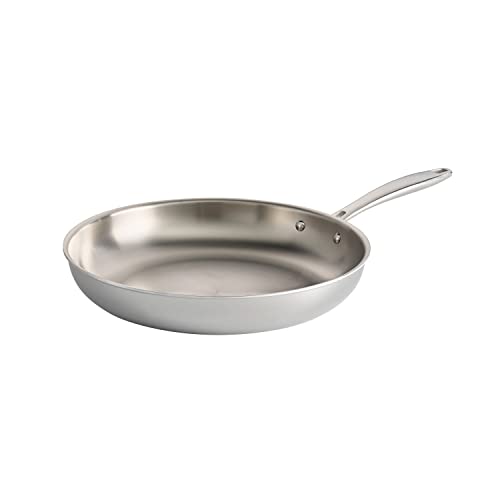
Tramontina Signature Tri-Ply Clad Stainless Steel 12-Inch Large Frying Pan
12 inWhat sticking actually is
Sticking is what happens when proteins in food form a bond with the metal surface of a pan before a stable crust has developed to separate the two. It is not a flaw in stainless steel and it is not solved by using more oil. It is a temporary chemical and mechanical bond that forms between the hot metal and whatever protein-rich food touches it first, and that bond breaks on its own once enough of a crust has formed underneath the food.
This is the single most common frustration people have when they switch from nonstick to stainless, and it is also the reason so many people give up on stainless cookware entirely. The pan is not defective. The technique used to preheat it usually is.
Why the bond forms in the first place
At the microscopic level, even a polished stainless surface has tiny pores and irregularities. When cold or undercooked protein touches hot metal, molecules in the protein can settle into those irregularities and form a bond with the metal atoms, similar to a weak weld. As long as that protein is still raw or only partially cooked at the contact point, the bond holds and the food will tear or stay stuck if you try to move it.
As cooking continues, the food at the contact point finishes cooking through, moisture cooks off, and the protein structure firms up into a crust. Once that crust is fully formed, it physically separates the food from the metal and the bond breaks. This is why food that seemed permanently stuck a minute earlier will often lift cleanly off the pan with a light nudge if you simply wait.
The preheat problem, not the pan problem
Most sticking comes down to one issue: the pan was not hot enough when the food went in. A properly preheated stainless pan runs hot enough that oil shimmers and thins out almost immediately, and a drop of water flicked onto the surface should bead up and skate across rather than sit still and evaporate slowly. Skipping this step and adding food to a lukewarm pan is the single biggest cause of sticking.
The fix is patience at both ends of the process: preheat the empty pan for a minute or two over medium heat before adding oil, let the oil heat until it moves freely, then add the food and leave it alone. Moving food around before it has released only tears the surface and drags raw protein back into contact with bare metal, restarting the bond.
Why "leave it alone" is the actual technique
Trying to flip or slide food before it has naturally released is the most common way people fight the pan instead of working with it. If a spatula meets resistance, the crust has not finished forming yet, and forcing the food will tear it rather than free it. Waiting another thirty seconds to a minute and testing again with a gentle nudge, rather than scraping, is the difference between a clean release and shredded fish or a stuck-on crust of egg.
This is also why searing works better on stainless than most people expect: the same mechanism that causes sticking is what builds the deep brown crust that gives seared meat its flavor. Sticking and searing are the same physical process at two different points in time.
Does the type of food change how much it sticks?
Proteins, meat, fish, chicken skin and eggs, are the foods most prone to the bonding mechanism that causes sticking, since it is the protein structure itself that forms the temporary bond with hot metal. Vegetables and starches behave differently: a properly heated pan with enough oil will usually let cut vegetables move fairly freely almost right away, because there is far less raw protein present to bond with the surface.
Fish is the most demanding case in a home kitchen because its protein structure is more delicate than red meat or poultry, and it forms a workable crust more slowly and more easily tears if moved too early. This is why fish is often the dish that convinces people stainless "does not work," when the real issue is usually rushing the release rather than any property of the pan.
Cleaning a stainless pan without damaging the surface
Stuck-on residue after cooking is not a sign of a ruined pan; it typically lifts easily once the surface has cooled enough to clean without warping it, or while it is still warm using liquid to deglaze the fond directly into a sauce. A dedicated stainless steel cleanser and a non-abrasive pad handle any residue that liquid alone does not lift, restoring the surface without scratching it.
Avoid plunging a hot stainless pan into cold water to speed up cleaning, since the sudden temperature change can warp thinner pans over repeated cycles even though stainless itself tolerates high heat well. Letting the pan cool for a few minutes before washing protects both the metal and, over time, the flatness of the base.
Gear for this job
- Bar Keepers Friend
Bar Keepers Friend Superior Cookware Cleanser & Polish | 12-Ounces | 1-Unit
$8.02 Check pricePrices change often - Cuisinart
Cuisinart Chef's Classic Stainless 14 Piece Set
14 pieces$169.96 Check pricePrices change often - All-Clad
All-Clad D3 Stainless Steel Fry Pan Set, 10&12-inch, Made in the USA
12 in$249.99 Check pricePrices change often


Common questions
Why does food stick to stainless steel but not nonstick pans?
Nonstick coatings use a chemically slick surface, PTFE or a ceramic sol-gel layer, that proteins cannot bond to in the first place. Stainless steel has no such coating, so proteins in food form a temporary bond directly with the hot metal until a crust develops and the food releases on its own. It is a different mechanism, not a defect in the stainless pan.
How do I know when a stainless pan is hot enough to add food?
Preheat the empty pan for a minute or two on medium heat, then add oil and watch it: properly heated oil thins out and shimmers within a few seconds rather than sitting thick and still. A water droplet test works too, a bead of water flicked onto a hot dry pan should skate across the surface rather than sit and slowly evaporate.
Should I use more oil to stop food sticking to stainless?
More oil does not fix sticking caused by an unheated pan. Oil helps transfer heat evenly and adds flavor, but the release itself depends on the pan being properly preheated and the food being left alone until the crust forms. Extra oil in a cold pan will not prevent the initial protein bond from forming.
Why does food that was stuck suddenly release on its own?
The protein bond that causes sticking only lasts until the contact point finishes cooking through and forms a stable crust. Once that crust is complete, it physically separates the food from the metal and the bond breaks, which is why food that resisted a spatula a minute earlier often lifts away cleanly with barely any pressure.
Is it normal for stainless pans to leave brown residue after cooking?
Yes. Browned residue, often called fond, comes from sugars and proteins caramelizing on the hot surface and is a normal part of cooking on stainless, not damage to the pan. It can be deglazed with liquid while still warm to lift it into a sauce, or cleaned afterward with a dedicated stainless cleanser.