The buy once cookware kit
Quick answer
The kitchen worth keeping is mixed, not matched. Clad stainless for searing and pan sauces, carbon steel for fast high-heat work, one nonstick pan for eggs, an enamelled dutch oven for anything acidic and slow, and a disc-base stockpot for boiling. No single material is good at all of those jobs.
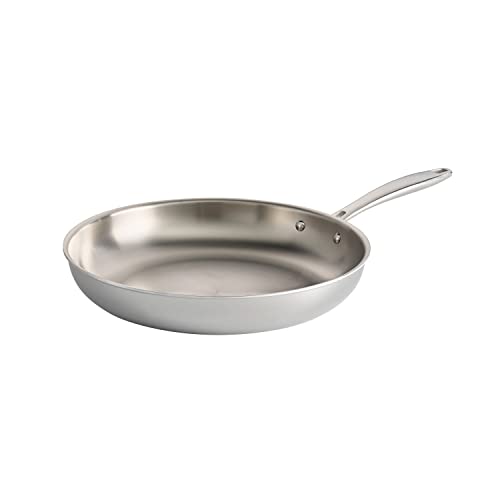
Tramontina Signature Tri-Ply Clad Stainless Steel 12-Inch Large Frying Pan
12 inFully clad means the aluminium core runs up the walls, not just across the base, so nothing scorches in a ring at the waterline. This is the pan for anything that ends in a pan sauce, because browned fond releases into liquid and seasoning does not have to survive it.
This is the point at which people stop buying sets and start buying pans. The organising idea is simple: choose each vessel for the job it is best at, and accept that the kitchen will not match.
Clad stainless goes where you need fond and a deglaze. Cast iron and carbon steel go where you need heat that does not drop. Nonstick goes where food would otherwise weld itself down. Enamel goes where the food is acidic and the cooking is long. Buying one of each beats buying five of any of them.
The complete kit
Prices come from live listings and move constantly. Treat the total as the shape of the budget rather than a quote.
Why each piece is here
Searing and sauces
Tramontina Signature Tri-Ply Clad Stainless Steel 12-Inch Large Frying Pan ($49.95): Fully clad means the aluminium core runs up the walls, not just across the base, so nothing scorches in a ring at the waterline. This is the pan for anything that ends in a pan sauce, because browned fond releases into liquid and seasoning does not have to survive it.
Tramontina Signature Tri-Ply Clad Stainless Steel 3-Quart Saute Pan ($57.78): Straight sides and a lid, so it browns and then braises in one vessel. For a given rim diameter it gives far more flat cooking surface than a skillet, because there is almost no loss from the flare. The most underrated piece in any kitchen.
High heat
OXO Obsidian 10" Carbon Steel Frying Pan, Pre-Seasoned Skillet ($57.91): Cast iron that responds. Same metal family, far thinner, so it heats and cools quickly while still taking a hard sear. It seasons faster than cast iron, weighs much less to lift one-handed, and it is what most professional kitchens actually use.
CAROTE 12 Inch Non Stick Frying Pan, Cream White Granite Skillet ($27.99): One good nonstick pan for eggs, pancakes and delicate fish. Buy the size you cook breakfast in rather than the largest available, since it will be replaced every few years and a smaller pan is cheaper to replace.
Slow cooking
Lodge Essential Enamel Cast Iron Dutch Oven, 6 Quart, Oyster White ($89.90): The single most capable pot in a kitchen. Enamel is inert, so long tomato and wine braises belong here rather than in bare cast iron where they would strip the seasoning. The iron body holds heat steadily enough for beans, stews and bread.
Boiling
Cuisinart 766-24 Chef's Classic 8-Quart Stockpot with Cover, Stainless Steel ($49.99): A disc-base pot is correct here and not a compromise: only the base does any work boiling water, and a thinner, lighter pot comes to the boil faster and is far easier to lift when full.
Ciwete 2 Quart Sauce Pan with Lid, Tri Ply Stainless Steel Saucepan 2 Qt with Stainless Steel Lid, 2 Measuring Lines, Upgraded Packaging, Cool Ergonomic Handle, Dishwasher & Oven Safe ($33.99): Grains, reductions and custards. Clad matters more here than in a stockpot, because a sauce reduced up the sides of a disc-base pan scorches at the waterline where the aluminium stops.
Oven
Nordic Ware Naturals Quarter Sheet, 2-Pack, Natural ($21.24): Commercial aluminium, 18 by 13 inches. Aluminium conducts about 237 W/m-K, roughly fifteen times better than stainless, which is why every professional kitchen uses bare aluminium sheet pans rather than coated ones.
Cooling Racks for Cooking and Baking - 11.5"x16.5" Oven Safe Premium Stainless Steel Heavy Duty Baking Rack Tight-Wire, Fits Half Sheet Pan for Roasting & Grilling & Cooking - Set of 2 ($24.29): Air under the food instead of a wet pan surface. It is the difference between crisp and soggy on anything roasted, and it doubles as a cooling rack for baking.
DOWAN Casserole Dish, 9x13 Ceramic Baking Dish, Large Lasagna Pan Deep for Oven, 4.2 Quarts Baking Pan with Handles, Oven Safe and Durable Bakeware for Lasagna, Home Decor, Wedding Gift, Soft White ($26.99): Ceramic or glass for gratins, baked pasta and anything that goes to the table. Note that glass is generally published at a lower oven ceiling than metal, commonly 425F, and prohibits the broiler.
Tools
TempPro TempSwift 1 Sec Instant Read Meat Thermometer Digital ($14.99): The only way to know when meat is done. It costs less than the first roast it rescues, and it removes the single largest source of guesswork in cooking.
Silicone Kitchen Utensils Set, Heat-Resistant Cooking Utensils, BPA-Free ($19.99): A thin flexible fish spatula does more than any other single utensil. Silicone or wood near the nonstick pan, and metal only near bare steel and iron.
Care
Herda 316L Cast Iron Scrubber Cleaner, Large Cast Iron Chain Mail Scrubber ($14.95): Chainmail takes stuck food off iron without stripping the seasoning, which is exactly what a detergent scrub would do. Seasoning is polymerised oil, not a coating, and it is maintained rather than permanent.
Bar Keepers Friend Cookware Cleanser & Polish (2 x 12 oz) Stainless Steel Cleaner & Degreaser for Pots, Pans, Bakeware & Grills - Removes Sticky Residue, Rust Stains & Lime Deposits ($16.49): Powdered stainless-safe cleanser restores a clad pan after a hard sear. Never use it, or steel wool, on nonstick or enamel.
Get this kit as a printable list
One page with every item in this kit and its current price, so you can cost the whole kitchen before you buy any of it. No sequence of sales emails.
We use this to send the list. You can also just read it on this page.What to skip
This is the part worth reading twice. Telling you not to buy something is what makes the rest of the list worth anything.
- A full matching clad set at this stage. You are deliberately mixing materials, and a set forces one material on every job.
- A copper pan. Copper conducts about 401 W/m-K and is genuinely the most responsive cookware there is. It is also expensive, heavy, needs polishing, and its advantage only shows in sugar work and delicate sauces.
- A grill pan, unless you specifically want the marks. The ridges keep most of the food off the hot metal, so it browns less than a flat skillet, not more.
- Ceramic nonstick as a replacement for PTFE. It avoids PTFE entirely, which is a real reason to choose it, and it generally loses its release sooner, so expect to replace it more often rather than less.
- A wok, unless you stir fry regularly on a powerful burner. On a standard domestic hob a wok never gets hot enough to do what it is for, and a large skillet does the job better.
What to upgrade first
- A larger clad skillet, if you routinely cook for four or more. Four portions seared need about 100 square inches of flat surface, which is a 14 inch pan rather than a 12 inch one.
- A whetstone and a proper knife, which will change more about daily cooking than any pan on this list.
- A second dutch oven in a smaller size, if you braise often. Two sizes covers weeknight and weekend.
Common questions
What does this cookware kit cost in total?
As listed it comes to $506.45 across 14 items, though prices move constantly and every card carries that warning. Treat the figure as the shape of the budget rather than a quote. It is worth noticing where the money actually goes, which is almost always the vessels and the blades rather than the accessories.
Do I need to buy everything at once?
No, and spreading it out is usually the better plan. One skillet, one pot and a knife will cook almost anything, and each further item is best bought when a specific meal has been difficult without it. Buying the whole list at once is how people end up with pieces they never reach for.
Why is there a separate ladder for knives?
Because cookware and knives are genuinely different purchases made by different people at different times. Someone replacing worn nonstick pans is not the same buyer as someone who has decided their knives are what is holding them back. Forcing both into one ladder would give weak advice to both.
What should I not buy from this list?
The "what to skip" section on this page lists it explicitly, and it is the part worth reading twice. On the cookware side, the thing to skip is almost always the padded set: the advertised piece count includes every lid, and above about twelve pieces the extra numbers are rarely pans.
Are these prices current?
They come from live retailer listings at build time and they change constantly, which is why every product card says so. The ordering and the ratios hold up far better than the exact figures, so use the total to understand how the budget distributes rather than as a quote.