Best dutch ovens
Quick answer
The Lodge Essential Enamel Cast Iron Dutch Oven, 6 Quart ($72.99) is the best all-around pick: it is foundry-cast in the USA, holds enough volume for the standard four-quarts-of-water-per-pound pasta rule with room to spare, and its enamel interior needs no seasoning.

Lodge Essential Enamel Cast Iron Dutch Oven, 6 Quart, Island Spice Red
6 qtThe Lodge Essential 6 quart sits at the sweet spot of capacity and durability. Six quarts covers a whole chicken, a loaf of no-knead bread, or a pot of pasta water using the four-quarts-per-pound rule with room left to keep it from boiling over. Its cast walls are thicker than the budget imported pots in this category, which means steadier heat retention for browning meat before a braise.
The three tiers
Beginner: Best first pot
someone who has never owned a dutch oven and wants to find out if they will actually use one before spending more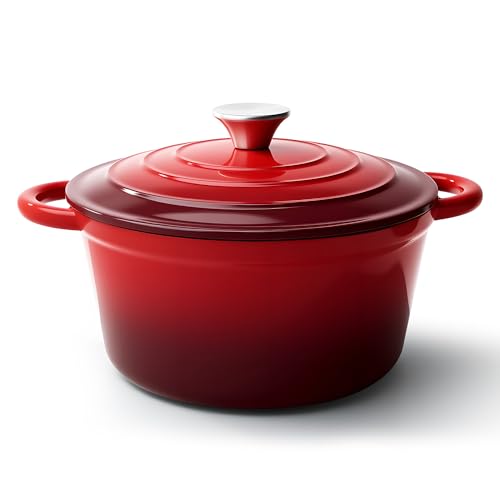
The Fijinhom 6 Quart Dutch Oven runs $30.99, making it one of the least expensive enameled cast iron pots with a full 6 quart capacity, enough to cover the four-quarts-of-water-per-pound pasta rule for a pound and a half of dry pasta. Because it is enameled rather than bare cast iron, there is no seasoning routine, no rust risk from a wet lid, and it goes straight into a dishwasher-averse but otherwise low-maintenance rotation. It is a reasonable way to learn whether braises, soups and no-knead bread are actually part of your cooking routine before committing three figures to the category.
Not for: someone who braises multiple times a week or sears at high heat often, since thinner cast walls and a lighter enamel coating on budget pots are more prone to chipping and uneven hot spots over years of heavy use
Intermediate: Best value
a home cook who braises, simmers soup or bakes bread on a weekly basis and wants a pot that will still be enameled clean in a decade- Intermediate pick
Lodge Essential Enamel Cast Iron Dutch Oven, 6 Quart, Island Spice Red
6 qt$72.99 Check pricePrices change often
The Lodge Essential Enamel Cast Iron Dutch Oven, 6 Quart, is $72.99 and is foundry-cast in the USA with thicker walls than most pots at this price. That extra mass evens out hot spots when searing and holds temperature through a long braise. Because the interior is enameled, it is inert: acidic tomato sauces, wine reductions and vinegar-based braises will not strip a seasoning layer the way they would in bare cast iron over long cook times. The light-colored enamel interior also makes it easy to watch fond build up on the bottom, which matters for deglazing.
Not for: someone who wants the lightest possible pot to lift one-handed, or who wants a wide range of enamel colors, since Lodge sells a narrower palette than boutique brands
Expert: Performance ceiling
a cook who braises often enough to justify a piece meant to last decades and be handed down- Expert pick
Le Creuset Enameled Cast Iron Signature Deep Round Oven, 6.5 qt., Sea Salt
6.5 qt$289.95 Check pricePrices change often

The Le Creuset Signature Deep Round Oven, 6.5 Quart, in Sea Salt runs $289.95. Le Creuset publishes a 500 degree F oven-safe rating for the enameled cast iron body, and the Signature line uses a machined rim for a tighter lid seal, which cuts moisture loss during a multi-hour braise. The sand-colored interior enamel resists staining better than dark interiors and makes it easy to judge browning. It carries a long manufacturer warranty that reflects how long these pots are built to last with normal home use.
Not for: someone who cooks a braise only a few times a year, or anyone who plans to broil or run the oven above the pot's rated knob temperature, since Le Creuset's standard lid knob is a separate spec from the pot body and should be checked before buying if high-heat oven finishing is part of the plan. This price is hard to justify for occasional use.
| Product | Price | Capacity | Oven safe |
|---|---|---|---|
| Fijinhom 6 Quart Dutch Oven | $30.99 | 6 qt | 500F (enamel body) |
| Lodge Essential Enamel Cast Iron Dutch Oven | $72.99 | 6 qt | 500F (enamel body) |
| Lodge Essential Enamel Cast Iron Dutch Oven, Oyster White | $89.90 | 6 qt | 500F (enamel body) |
| Le Creuset Signature Deep Round Oven, Sea Salt | $289.95 | 6.5 qt | 500F (enamel body, check knob rating) |
Is a dutch oven worth buying if I am just starting to cook?
A dutch oven earns its shelf space faster than most single-purpose cookware because it covers braising, soup, stew, no-knead bread and even deep frying in a pinch, all in one vessel that goes from stovetop to oven. For someone still building a kitchen from scratch, a mid-range enameled pot in the 6 quart range is a reasonable first big purchase precisely because it replaces several other pots rather than adding to the pile.
The main risk for a beginner is buying too small or too large. A 4 to 5 quart pot feels sufficient until you try to fit a whole chicken with vegetables around it, or a pound and a half of pasta water without it threatening to boil over. Starting around 6 quarts avoids most of that regret without tipping into a pot so heavy and large it becomes awkward to lift out of a low oven when full of liquid.
Why do enameled dutch ovens list a lower knob temperature than the pot body?
The pot body and the lid knob are frequently made of different materials and tested to different limits, even on the same product. Cast iron with a baked enamel coating tolerates high, sustained oven heat well, which is why 500 degree F ratings are common for the pot itself. Many lid knobs, however, are a hard phenolic plastic chosen for a comfortable grip, and phenolic has a lower heat tolerance, often around 375 degrees F.
Practically, this matters most for recipes that call for browning under high heat with the lid on, or finishing under a broiler. If your usual cooking stays in the 325 to 375 degree F braising range, the knob rating is rarely an issue. If you regularly push higher, either confirm the specific knob rating for the pot you are considering or budget for a metal replacement knob, which several manufacturers sell separately and which typically matches the full rating of the pot body.
Can I use a dutch oven on a glass-top or induction cooktop?
Cast iron, whether bare or enameled, is magnetic and works on induction cooktops without an adapter, which is one advantage over some aluminum and copper cookware. On a glass or ceramic smooth-top range, cast iron works too, but its rough exterior and significant weight make it easy to scratch the glass surface if it is dragged rather than lifted when moving it on and off the burner.
The heavier the pot, the more this matters. A full 6 or 7 quart dutch oven loaded with braising liquid can weigh well over 15 pounds, so lifting rather than sliding it protects both a glass cooktop and the enamel finish on the pot's own base, which can chip from repeated scraping just as easily as the top can.
When should I replace an enameled dutch oven instead of keeping it?
Small surface staining or a dulled interior sheen is cosmetic and does not affect function; enamel is glass fused to metal and inert food-contact stains do not compromise it. What does matter is a chip or crack in the enamel that exposes the bare cast iron underneath, especially on the interior cooking surface, since that spot can begin to rust and will no longer be the inert surface enamel is chosen for in the first place.
A warped base that rocks on a flat stovetop, usually from repeated extreme thermal shock such as plunging a hot pot into cold water, is the other common failure point and is not something that can be repaired at home. Either issue is a reasonable reason to retire a pot rather than keep cooking acidic food against exposed iron.
Is Le Creuset worth the price difference over Lodge or budget enameled cast iron?
The price gap between a $73 Lodge and a $290 Le Creuset is not explained by the core material, both are enameled cast iron rated for similarly high oven temperatures. The difference shows up in wall thickness consistency, the precision of the lid-to-rim fit, the resistance of the interior enamel to staining over years of tomato sauce and wine reductions, and a warranty that reflects decades of expected use.
For someone who braises a few times a season, that gap is hard to justify against a well-reviewed budget or mid-tier pot doing the same core job. For someone who braises weekly for years and wants a single pot that outlasts several cheaper replacements, and who values the tighter seal for long, low braises, the premium line earns its keep more clearly.
How we chose
This guide is researched from published manufacturer specifications, listed materials and capacities on each product page, and patterns in verified owner reviews. Nothing here reflects hands-on cooking or side-by-side testing in a kitchen. Where a manufacturer publishes an oven-safe temperature, a quart capacity, or a construction detail such as enameled versus bare cast iron, that published number is what is cited, and it is flagged clearly whenever a detail such as knob material is not confirmed for a specific listing.
Selections favor pots with a documented quart capacity that maps to real cooking tasks (a whole chicken, a loaf of bread, a pound or more of pasta water) over pots chosen purely on price or star rating. Enamel quality, wall thickness relative to price, and whether a listing discloses country of manufacture were weighted heavily, since those factors show up most often in long-term owner complaints about chipping, warping or uneven heating.
Buying tips
What size dutch oven do I actually need?
Start from what you cook most. The standard pasta-water rule is four quarts of water per pound of dry pasta, so a one pound box needs at least a six quart pot to avoid a rolling boil that spills over the rim. A five to 5.5 quart oval or round pot is the traditional size for a whole chicken or a loaf of no-knead bread. Families of five or more, or anyone who batch-cooks soup and stew for the freezer, tend to outgrow a 5.5 quart pot fast and are usually happier starting at 7 quarts. Bigger is not automatically better: a 6 quart pot half-full of braising liquid heats and reduces faster than an 8 quart pot with the same amount of liquid lost in a wider, shallower puddle.
Enameled or bare cast iron, which one should I buy?
Enameled cast iron is inert, so it never needs seasoning and it will not react with or lose seasoning to acidic ingredients like tomatoes, wine or vinegar during a long braise, which is exactly the kind of cooking a dutch oven is built for. Bare cast iron is tougher against high, dry heat and costs less, but a long acidic braise will strip its seasoning layer and it needs re-seasoning afterward. Enamel has its own weak points: it chips if dropped or banged against a faucet, and it dislikes thermal shock, so never set a hot enamel pot directly on a cold countertop or pour cold liquid into a screaming hot enamel pot. See the enameled versus bare cast iron comparison for a full side-by-side.
Why does my dutch oven have two different oven-safe temperatures?
Most enameled cast iron pot bodies are rated to 500 degrees F by their manufacturers, but the lid knob is a separate part with its own rating. A phenolic (hard plastic) knob is commonly rated only to about 375 degrees F, which means the knob, not the enameled pot, becomes the real ceiling on how hot your oven can go with the lid on. If a recipe calls for a 450 to 500 degree F oven, check the knob material specifically before assuming the whole pot can handle it; some brands sell a metal replacement knob rated for the full oven-safe temperature of the pot body.
Does a tight-sealing lid actually matter?
Yes, for braising specifically. A heavy, well-machined lid that sits flush against the rim traps steam and returns condensation to the pot, which keeps a low, slow braise from drying out over two or three hours in the oven. A warped or loosely fitting lid lets more moisture escape as steam, which means checking the pot more often and topping up liquid. This is one of the differences that separates a budget enameled pot from a heavier, more precisely machined one, even when both list the same quart capacity.
Other options worth knowing about
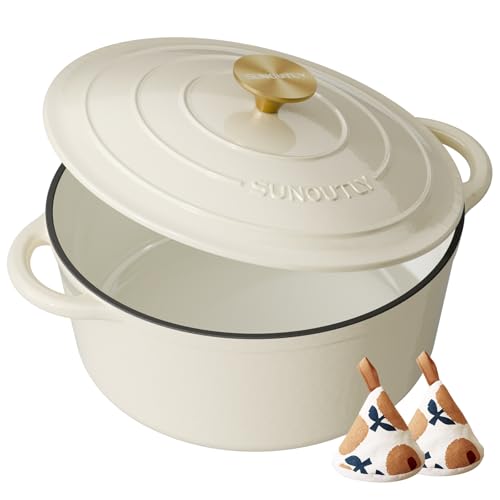
- SUNOUTLY
Enameled Cast Iron Dutch Oven, 6QT Pot with Lid, Cream White
6 qt$49.98 Check pricePrices change often - Le Creuset
Le Creuset Enameled Cast Iron Round Dutch Oven, 5.5 qt., Cerise
5.5 qt$289.99 Check pricePrices change often - Le Creuset
Le Creuset Enameled Cast Iron Round Dutch Oven, 7.25 qt., Cerise
7.25 qt$325.99 Check pricePrices change often


Safety
Common questions
What quart size dutch oven is best for a family of four?
A 6 quart dutch oven is the most common recommendation for a family of four. It comfortably fits a whole chicken with root vegetables, a double batch of chili, or a pound to a pound and a half of pasta cooked using the four-quarts-of-water-per-pound rule. Families that batch-cook soup for the freezer regularly, or that regularly cook for five or more, are often happier moving up to a 7 quart pot instead.
Do I need to season an enameled dutch oven?
No. Enameled cast iron has a glass-based coating fused to the metal that is already a nonstick-adjacent, inert cooking surface, so it does not need the oil-and-heat seasoning process that bare cast iron requires. Bare cast iron dutch ovens, like Lodge's uncoated line, do need seasoning and re-seasoning, especially after cooking anything acidic for a long time.
Can a dutch oven go in the dishwasher?
Most manufacturers recommend hand washing enameled cast iron even when the listing says dishwasher safe, because repeated dishwasher cycles with harsh detergent can dull the enamel's finish over years of use. A soak in warm soapy water followed by a non-abrasive sponge handles stuck-on food without the long-term wear a dishwasher adds.
Why did my enameled dutch oven crack?
Cracking or chipping in enamel is almost always caused by thermal shock (a sudden, extreme temperature change) or a physical impact such as being dropped or banged against a faucet. Pouring cold liquid into a very hot empty pot, or setting a hot pot on a cold wet countertop, are two of the most common ways owners report cracking the enamel.
Is a lighter dutch oven better than a heavier one?
Not necessarily. Weight in cast iron cookware comes from wall thickness, and thicker walls generally hold and distribute heat more evenly, which is exactly what a braise or a low, slow simmer benefits from. A lighter pot is easier to lift, but it is often lighter because the walls are thinner, which can mean more uneven hot spots when searing.
What is the difference between round and oval dutch ovens?
Round dutch ovens distribute heat most evenly around the pot and suit soups, stews, and rice or bread baking. Oval dutch ovens are shaped to fit a whole chicken, a roast, or a whole fish more naturally without wasted space. Round pots are the more common first purchase; oval pots are usually a second pot bought once a specific need for the shape shows up.