German vs Japanese Chef's Knives
Quick answer
Buy the Wusthof Classic 8-Inch Chef's Knife ($100.00) for a tougher, more forgiving edge that holds up to bone contact and heavy chopping; buy the Shun Classic 8-Inch Chef's Knife ($140.14) for a noticeably sharper, thinner edge on precise vegetable and protein cuts.
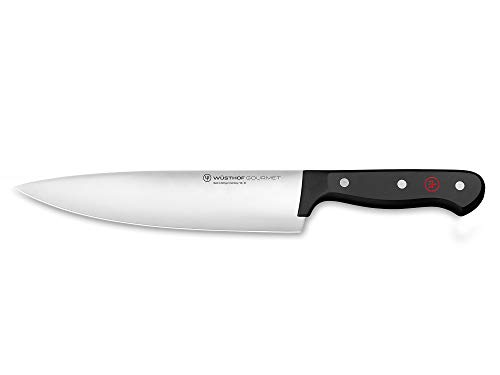
Wüsthof 8" Gourmet Chef's Knife
8 inCooks who want a tougher edge that tolerates occasional bone contact, rock-chopping technique, and less frequent sharpening.
| German (Wusthof Classic) | Japanese (Shun Classic) | |
|---|---|---|
| Steel hardness | About 56 to 58 HRC | About 60 to 64 HRC |
| Edge angle per side | About 14 to 20 degrees | About 10 to 16 degrees |
| Sharpness out of the box | Sharp, but less acute | Noticeably sharper |
| Edge retention | Shorter between sharpenings | Longer between sharpenings |
| Chip resistance | More forgiving of bone contact | More prone to chipping |
| Recommended cutting motion | Rock chop, tolerates twisting | Straight push or pull cuts preferred |
| Price | $100.00 | $140.14 |
Why steel hardness explains most of the difference
The core difference between German and Japanese kitchen steel comes down to a single measurement, Rockwell hardness, abbreviated HRC. German knives like the Wusthof Classic typically run 56 to 58 HRC, a moderately soft steel by kitchen knife standards. Japanese double-bevel knives, including the Shun Classic, typically run 60 to 64 HRC, several points harder on a scale where each point represents a meaningfully stiffer, more brittle steel structure. This is the same Rockwell scale used to rate other hardened steel tools, and the same general tradeoff applies across all of them: harder holds an edge longer but chips more easily.
Harder steel holds a thinner, more acute edge without that edge immediately rolling over or deforming, which is why harder Japanese steel can be ground sharper and stay sharp longer. The cost of that hardness is brittleness: harder steel is more prone to chipping on contact with bone, a frozen ingredient, or a hard twisting motion against a cutting board.
Edge angle: the other half of the equation
Steel hardness alone does not determine sharpness; the angle the edge is ground to matters just as much. German knives are typically ground at 14 to 20 degrees per side, a wider angle that creates a thicker, more durable edge at the cost of ultimate sharpness. Japanese double-bevel knives are typically ground at 10 to 16 degrees per side, a narrower angle that slices with less resistance but leaves less metal behind the edge to resist damage.
These two factors, harder steel and a narrower angle, compound each other in the Japanese knife: harder steel can actually hold that narrower angle without immediately rolling, while the same narrow angle on softer German steel would deform and dull almost immediately. That is why the two traditions pair specific hardness ranges with specific edge angles rather than mixing and matching, and why simply resharpening a German knife at a narrower angle will not turn it into a Japanese-style performer.
How this shows up in actual cutting feel
A Japanese knife like the Shun Classic will feel noticeably sharper straight out of the box and will glide through a tomato, an onion, or a piece of raw fish with less resistance than a German knife of similar quality. That thinner edge geometry is genuinely better for precise, clean cuts where minimizing cell damage to the ingredient matters, like sashimi-style protein slicing or fine julienne work.
A German knife like the Wusthof Classic will feel slightly less razor-sharp in direct comparison but will tolerate a wider range of cutting techniques and ingredients without immediate edge damage. It handles the occasional bone, a stray twist against a cutting board, or a rock-chopping motion through a stack of herbs better than a harder, thinner Japanese edge would.
This difference is most obvious on soft, high-moisture produce like ripe tomatoes, where a thin, hard Japanese edge slices through the skin cleanly with minimal downward pressure, while a German edge can bruise or crush the same tomato slightly if the blade is not kept properly sharp between uses.
Edge retention and how each knife should be sharpened
Japanese steel's higher hardness generally means it holds a sharp edge longer between full sharpenings, since harder steel resists the gradual rolling and wear that dulls a blade during normal use. German steel needs more frequent honing and, over time, more frequent full sharpening to maintain a comparable edge, simply because its softer steel rolls and dulls faster under the same use. This is a direct consequence of the hardness each steel type was designed around, not a flaw in either knife.
German knives are traditionally maintained with a honing steel between full sharpenings and a whetstone or pull-through sharpener for restoring the edge, tools generally forgiving of small angle inconsistencies given the wider edge angle involved. Japanese double-bevel knives are best maintained with a whetstone specifically, since a pull-through sharpener designed around a wider German-style angle can actually widen a Japanese edge over time, reducing exactly the sharpness advantage that made the knife worth buying.
Chipping risk and how technique needs to adapt
Because Japanese knives run harder and thinner, they are genuinely more prone to chipping, especially from bone contact, frozen food, or a hard side-to-side twisting motion used to loosen stuck food from the blade. Cooks who choose a Japanese-style knife generally need to adjust technique: straight push or pull cuts rather than twisting, and switching to a cleaver or a dedicated boning knife for any task involving bone.
German knives are noticeably more forgiving of these situations. Occasional light bone contact, a rock-chopping motion through a pile of vegetables, or twisting the blade slightly to pry apart stuck food will not typically chip a German edge the way it could a harder Japanese one, which is part of why German knives remain popular for cooks who want one knife that tolerates varied kitchen tasks.
A small chip in a Japanese blade is usually repairable on a whetstone, though it requires grinding down enough surrounding steel to remove the damaged section entirely, which can take noticeably longer than repairing a similar chip in a softer German edge. This repair time is worth factoring in for anyone considering a Japanese knife as their only chef's knife rather than as a second, more specialized blade.
Handle design, balance, and rust resistance
German knives like the Wusthof Classic typically use a full bolster, a thick collar of metal between the blade and handle, which shifts weight toward the handle and creates a more blade-heavy, substantial feel that many cooks associate with control during heavy chopping. Japanese double-bevel knives in a Western handle style, like the Shun Classic, generally skip the full bolster, creating a lighter, more forward-balanced feel that some cooks find better suited to precise slicing motions. The Wusthof uses a synthetic polymer handle riveted to a full tang, while the Shun uses a similar synthetic material in its Western-style handle rather than a traditional Japanese wa handle.
Both the Wusthof Classic and the Shun Classic use stainless steel formulations, meaning both resist rust reasonably well under normal kitchen use and drying habits, unlike traditional high-carbon Japanese steels that can rust quickly if left wet. This makes both knives referenced here low-maintenance from a corrosion standpoint, with the harder Shun steel benefiting slightly more from prompt drying after washing simply because it is a more specialized, higher-performance steel worth protecting.
Which one to actually buy
For a first serious chef's knife intended for general, varied kitchen prep, including occasional rough handling, the Wusthof Classic 8-Inch Chef's Knife at $100.00 is the more forgiving, lower-maintenance choice. For a cook who already handles a knife carefully, values maximum sharpness for precise cuts, and does not mind more frequent honing, the Shun Classic 8-Inch Chef's Knife at $140.14 delivers a noticeably sharper, longer-lasting edge in exchange for that added care.
Japanese (Shun Classic)

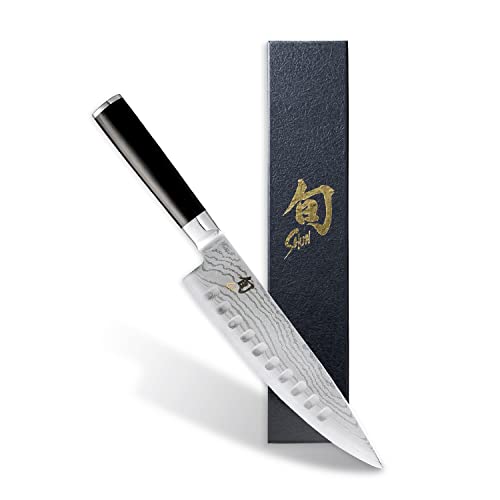
Shun Classic 8" Chef's Knife
8 inCooks who want a thinner, sharper edge for precise slicing and are comfortable using more careful technique and more frequent honing.
Both sides of this comparison
- MIYABI
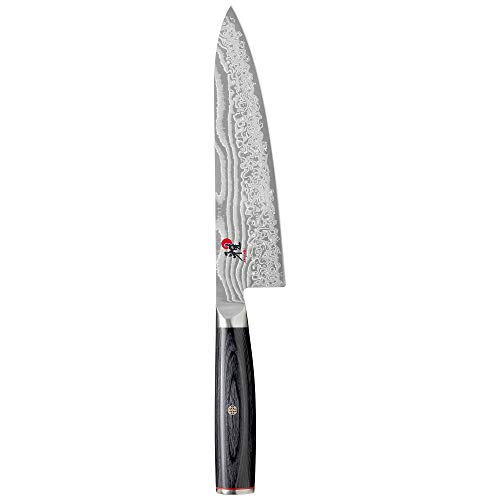
Miyabi Evolution Chef's Knife, 8", Stainless Steel
8 in$139.95 Check pricePrices change often - MIYABI
Miyabi Kaizen II 8-inch Chef's Knife, Stainless Steel
8 in$169.95 Check pricePrices change often



Common questions
Is a Japanese chef's knife sharper than a German one?
Yes, generally. Japanese double-bevel knives use harder steel, typically 60 to 64 HRC, ground at a narrower 10 to 16 degree angle per side, both of which produce a sharper edge than German knives, which run softer steel around 56 to 58 HRC at a wider 14 to 20 degree angle.
Why do Japanese knives chip more easily than German knives?
Japanese knives use harder steel ground at a thinner angle, and harder steel is inherently more brittle than softer steel. That combination produces a sharper edge but one that is more likely to chip on contact with bone, a frozen ingredient, or a hard twisting motion, compared to a German knife's tougher, more forgiving edge.
How often do I need to sharpen a German versus a Japanese knife?
German knives typically need more frequent honing and full sharpening since their softer steel dulls faster under normal use. Japanese knives, with harder steel, generally hold an edge longer between sharpenings, though both benefit from regular honing with a honing steel to keep the edge aligned between full sharpenings.
Can I use a Japanese knife to cut through bone?
It is not recommended. The harder, thinner edge on a Japanese double-bevel knife is more likely to chip on bone contact than a German knife's tougher edge. Use a dedicated boning knife or a cleaver for any task involving bone, regardless of which chef's knife style is being used for general prep.
What does HRC mean on a kitchen knife?
HRC stands for Rockwell hardness on the C scale, a standard measurement of how hard a piece of steel is. German kitchen knives typically measure 56 to 58 HRC, while Japanese double-bevel knives typically measure 60 to 64 HRC, with higher numbers indicating harder, more edge-retentive but also more brittle steel.
Is a German or Japanese knife better for a beginner?
A German knife is generally more forgiving for a beginner, since its tougher edge tolerates imperfect technique, occasional twisting, and varied cutting tasks without chipping. A Japanese knife rewards more careful, deliberate technique and is a better fit once a cook is comfortable using straight push or pull cuts and avoiding bone contact.