Knife steel and hardness explained
Quick answer
Knife steel hardness is measured on the Rockwell C scale (HRC): common German steel runs about 56 to 58 HRC, Japanese stainless steels like VG-10 run about 60 to 61 HRC, and premium powder steels like SG2 or ZDP-189 run about 63 to 66 HRC, with harder steel holding an edge longer but chipping more readily than softer steel.
HRC ranges by steel type are published metallurgical specifications from steel manufacturers and knife makers.
| Steel | Typical HRC | Origin | Stainless |
|---|---|---|---|
| X55CrMo14 (Victorinox) | About 55 to 56 | Swiss/German style | Yes |
| X50CrMoV15 | About 56 to 58 | German | Yes |
| VG-10 / VG-MAX | About 60 to 61 | Japanese | Yes |
| Shirogami / Aogami | About 61 to 63 | Japanese | No (carbon steel) |
| SG2 / R2 (powder steel) | About 63 to 64 | Japanese | Yes |
| ZDP-189 | About 64 to 66 | Japanese | Yes |

What HRC actually measures
HRC, or Rockwell C hardness, is a standardized measurement of how much a material resists a small, calibrated indenter being pressed into its surface, and it is the number knife makers use to describe how hard a blade's steel has been heat-treated. A higher HRC number means the steel resists deformation more, which in a knife blade translates directly to how long an edge stays sharp under normal cutting use.
HRC is not the whole story of how a knife performs, since alloy composition, grain structure and the specific heat treatment a maker applies all matter too, but within a given steel family, hardness is the single most useful number for predicting edge retention versus chip resistance.
The core hardness trade-off
Harder steel holds a sharp edge for longer under cutting use, because it resists the microscopic rolling and deformation that dulls a blade over time. That same hardness makes the steel more brittle, so a harder blade is more likely to chip if it strikes a bone, a hard cutting board, or is twisted while stuck in food, rather than simply rolling the way a softer edge would under the same stress.
This is why no single steel is objectively "best." A steel hardened to 64 HRC will out-hold a steel at 56 HRC in a straight edge-retention comparison, but the softer steel will tolerate rougher treatment, awkward cuts, bone contact and careless storage far better than the harder one will.
German steel: tough, moderate hardness
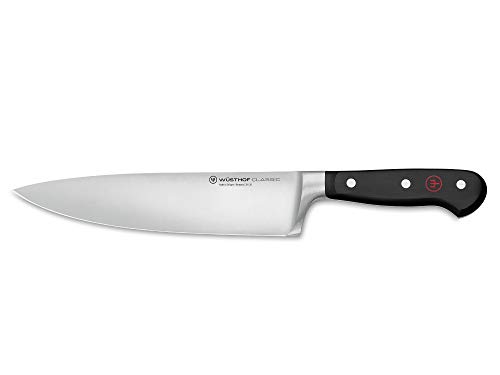
German cutlery steel, most commonly X50CrMoV15, typically runs about 56 to 58 HRC, a moderate hardness that favors toughness over maximum edge retention. This is a deliberate choice, not a limitation: German knife design generally pairs this steel with a thicker edge geometry, roughly 14 to 20 degrees per side, built to handle rougher use, bone contact and less delicate care without chipping.
A related steel, Victorinox's X55CrMo14, runs slightly softer still, about 55 to 56 HRC, and is used in some of the most widely sold value chef knives on the market specifically because that combination of moderate hardness and tough steel tolerates the kind of everyday abuse a knife sees in a busy kitchen.
Japanese stainless steel: harder, finer edges
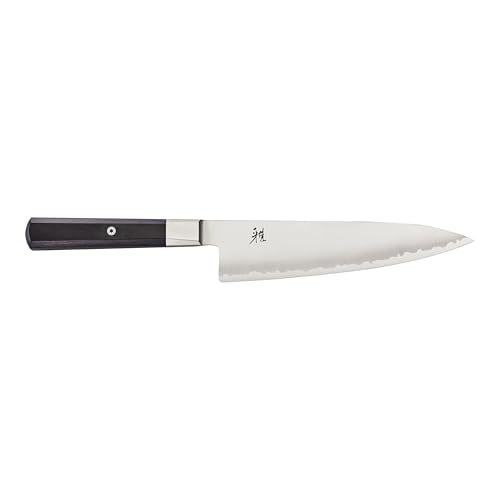
Japanese stainless steels aimed at Western-style chef knives and santokus, most notably VG-10 and the related VG-MAX, typically run about 60 to 61 HRC, noticeably harder than common German steel. That extra hardness lets Japanese blades be ground to a thinner edge, typically about 10 to 16 degrees per side, without the edge rolling as quickly as a similarly thin German edge would, which is part of why Japanese knives are often described as feeling sharper and more precise for fine slicing work.
Powder steels take this further. SG2, also sold as R2, is produced using powder metallurgy for a more uniform grain structure and typically runs about 63 to 64 HRC, while ZDP-189 pushes even higher, typically about 64 to 66 HRC. Both hold an edge exceptionally long but are correspondingly less forgiving of hard impacts or twisting stress than softer steels.
Japanese carbon steel: hardest common option, not stainless
Traditional Japanese carbon steels, most commonly Shirogami (White steel) and Aogami (Blue steel), typically run about 61 to 63 HRC and are prized by some cooks for taking an extremely fine edge and for being relatively easy to sharpen despite their hardness, compared with some powder steels. The trade-off is that these are genuinely carbon steels, not stainless, so they will react with acidic food and develop a patina, and can rust if left wet, requiring more attentive drying and occasional oiling than a stainless blade needs.
How hardness should guide sharpening choices
Hardness is not just a marketing number; it determines what sharpening tools and angles actually work on a given blade. Softer German steel, around 56 to 58 HRC, holds up well to a pull-through sharpener's fixed-angle wheels and a slightly steeper edge, roughly 14 to 20 degrees per side, because the steel flexes and rolls rather than chipping under that kind of grinding pressure.
Steel hardened above roughly 61 HRC, the range where VG-10, powder steels and Japanese carbon steels all sit, needs a whetstone rather than a pull-through sharpener, since a fixed-angle wheel grinding aggressively against a harder, thinner edge, typically 10 to 16 degrees per side, risks chipping rather than sharpening it cleanly. Anyone choosing a knife in this harder steel range should plan on a whetstone as part of ordinary ownership, not an occasional upgrade.
Gear for this job
- BABOSTOW
BABOSTOW Knife Sharpening Stone 1000/6000 Grit with Base & Angle Guide
$12.14 Check pricePrices change often



Common questions
What does HRC mean on a knife?
HRC stands for Rockwell C hardness, a standardized scale measuring how much a material resists a calibrated indenter pressed into its surface. On a kitchen knife, a higher HRC number generally means the blade holds a sharp edge longer under normal cutting use, at the cost of becoming more brittle and more prone to chipping under hard impact or twisting stress.
Is harder knife steel always better?
Not universally. Harder steel holds an edge longer, but it is also more brittle and chips more readily on bone, hard cutting boards, or awkward twisting cuts. Softer steel, common in German knives at about 56 to 58 HRC, tolerates rougher handling and is often easier to resharpen, so the "better" choice depends on how carefully the knife will be used and cared for.
What is the hardness of German knife steel compared to Japanese steel?
German cutlery steel, typically X50CrMoV15, runs about 56 to 58 HRC. Japanese stainless steels used in comparable knives, such as VG-10, typically run harder, about 60 to 61 HRC, and premium Japanese powder steels like SG2 or ZDP-189 run harder still, about 63 to 66 HRC.
Is Japanese carbon steel stainless?
No. Traditional Japanese carbon steels like Shirogami and Aogami, typically about 61 to 63 HRC, are not stainless. They can react with acidic foods, develop a patina over time, and will rust if left wet, so they need more attentive drying and occasional oiling compared with a stainless blade of similar hardness.
Why do Japanese knives use a thinner edge angle than German knives?
Japanese knives are typically made from harder steel, often 60 HRC or above, which can support a thinner edge, roughly 10 to 16 degrees per side, without rolling as quickly as a similarly thin edge on softer steel would. German knives use moderate-hardness steel around 56 to 58 HRC and are typically ground at a thicker 14 to 20 degrees per side to stay tough enough for rougher use.
What is powder steel and why is it so hard?
Powder steel, such as SG2 (also sold as R2) or ZDP-189, is produced by compacting fine metal powder into a uniform structure through powder metallurgy, rather than the conventional casting process used for most steel. This produces a finer, more even grain structure, which lets makers push hardness higher, typically 63 to 66 HRC, while still holding a usable edge.